
In 2026, the global paint roller production equipment industry is undergoing a profound transformation from labor-intensive to technology-intensive operations.
From March 24 to 25, the 22nd Hot Melt Adhesive Industry Innovation and Development Forum was successfully held in Suzhou, bringing together over 500 participants including hot melt adhesive manufacturers, equipment suppliers, and research institutions from across China, comprehensively focusing on the green, intelligent, and high-end development of the hot melt adhesive industry. From April 15 to 17, the 2026 WEPACK World Expo for Packaging grandly opened at the Shenzhen World Exhibition & Convention Center, where Guangzhou Keqirui Machinery Equipment Co., Ltd. showcased its core hot melt adhesive equipment and new solutions, becoming a focal point of the exhibition. In April, at the FEIBP Congress in Edinburgh, Scotland, Edward Jackson (Engineer) Ltd's Jackson Helix thermo-bonding winding machine was officially presented as a strong contender for the FEIBP Innovation Award, continuing to attract significant interest among roller makers since its launch at the Interbrush show in April. Edward Jackson has been supplying high-quality, reliable machines to the global paint roller industry for over 45 years.
Meanwhile, the paint roller end-market continues to show strong growth. The global paint rollers market size is projected to grow from USD 3.48 billion in 2025 to USD 3.78 billion in 2026, at a compound annual growth rate of 8.5%. Other research institutions forecast that the global paint rollers market will reach USD 5.2 billion by 2034.
These industry developments collectively point to a clear direction: paint roller production equipment is accelerating its transition from the traditional flame plus manual model toward a new era of servo drive, intelligent control, and thermal fusion bonding precision manufacturing. In this process, the fully automatic thermal fusion winding machine, with its unique advantages of eliminating open-flame safety hazards and significantly improving production efficiency and quality consistency, is becoming the standard configuration for paint roller manufacturers worldwide.
I. Market Drivers: Three Forces Driving Equipment Upgrades
The growth of the global paint roller production equipment market is driven by three structural forces.
Rising labor costs driving automation substitution. Traditional roller production is a labor-intensive industry. With rising labor costs and increasingly prominent recruitment difficulties worldwide, manufacturers are more inclined to invest in automated equipment to reduce reliance on manual labor and improve production efficiency and quality stability. The fully automatic thermal fusion winding machine enables one operator to manage multiple machines, with production output reaching up to 9 meters per minute, significantly reducing labor requirements while greatly increasing production volume and quality. The complete process from tube preparation to final roller cutting can be fully automated.
Product diversification and customization demands. Market demand for rollers is becoming increasingly diverse, including different materials (wool, synthetic fiber, blended), different sizes (short pile, medium pile, long pile), and different applications (latex paint, water-based paint, oil-based paint, specialty coatings). This requires production line equipment to possess higher flexible production capabilities to quickly switch between different product specifications. The fully automatic thermal fusion winding machine, through its servo control system and parameterized adjustment, can rapidly adapt to different tube diameters and different fabric widths.
Tightening environmental and safety regulations. Traditional flame winding processes present open-flame safety hazards and environmental pollution issues. Hot melt adhesive extrusion bonding technology replaces flame processes, combined with automatic tube feeding and robotic arm coordination, fundamentally eliminating open-flame hazards and improving the working environment. At the 2026 Hot Melt Adhesive Industry Innovation and Development Forum, the industry clearly identified green upgrading and smart manufacturing transformation as core development directions.
II. Technological Revolution: The Leap from Flame to Thermal Fusion
In 2026, technological advancements in paint roller winding equipment are focused on three core directions.
(I) Thermal Fusion Bonding Replacing Flame Process: A Dual Leap in Safety and Quality
Traditional roller brush winding machines use flame methods by burning the tube surface with gas to melt it, then manually wrapping the fabric around it. This process has multiple defects: open-flame operations present serious safety hazards; manual operations cannot guarantee consistent speed, resulting in inconsistent product gaps and unstable quality; production output is only 1.2 meters per minute, with extremely low efficiency.
The new generation of fully automatic thermal fusion winding machines replaces the flame process with hot melt adhesive extrusion bonding technology, combined with automatic tube feeding and robotic arm coordination, enabling all mechanisms to operate in a coordinated production process. Hot melt adhesive is melted at controlled temperatures and uniformly applied to the tube surface, after which the fabric and tube are bonded under pressure. The entire process requires no open flame, no smoke emissions, and no VOC emissions.
In terms of bond strength, the thermal fusion bonding process forms bonds significantly stronger than traditional flame processes. International research shows that thermo-fusion technology combines fabric and plastic tube into a single unit using heat and mechanical pressure. Beorol's thermo-fusion process bonds polyurethane to plastic tubes through a thermo-fusion system, guaranteeing significantly longer service life than conventional adhesive bonding methods. Thermo-fusion technology heat-bonds fabric to the plastic core without adhesives, significantly increasing bond strength and durability.
(II) Full Servo Control System: From Mechanical Execution to Precision Intelligent Control
The full servo control system is the core technical feature of the new generation of thermal fusion winding machines. Through the coordinated operation of servo motors, programmable logic controllers (PLC), and human-machine interfaces, precise control over the entire winding process is achieved.
The core advantages of the full servo control system include: strong system stability with no degradation of precision over long-term operation; high production efficiency with stable production speeds reaching up to 8 meters per minute; stable product quality with automated operations eliminating quality fluctuations caused by operator skill variations; and convenient adjustment with simple parameter changes for rapid product specification changes.
In terms of control architecture, the export standard configuration adopts the Siemens control system from Germany (touch screen + PLC + servo motor), while the standard configuration adopts China's innovative control system (touch screen + PLC + servo motor). At the 2026 Hannover Messe, Siemens demonstrated breakthrough progress in industrial AI moving from the experimental stage to real-world applications: AI agents autonomously managing production processes, humanoid robots handling material transport, and AI-controlled robots completing final packaging. This trend is penetrating the packaging and winding equipment sector, pointing the way for the intelligent upgrading of thermal fusion winding machines.
(III) Modular and Precision Design: Enhancing Equipment Reliability and Adaptability
The new generation of thermal fusion winding machines has also achieved significant breakthroughs in mechanical structure design.
Integrated precision slide rail modules. The adoption of standard integrated precision slide rail modules delivers high precision, excellent stability, and long-lasting durability. Precision slide rails ensure that all moving components maintain precise relative positions during long-term operation, forming the physical foundation for consistent winding precision.
Maintenance-free rotating clamping assemblies. The maintenance-free rotating clamping assembly, with its brushless conductive ring design, reduces maintenance costs and increases production capacity. Conductive rings in traditional equipment are wear parts requiring periodic replacement; the maintenance-free design fundamentally eliminates this maintenance pain point.
Locking claw mechanism innovation. The patented fully automatic roller brush winding machine technology uses a locking claw mechanism to clamp the tube end, achieving radial-restriction-free winding. The locking claw mechanism works by externally clamping the tube end, allowing the production of roller brushes without tube diameter limitations. This design enables the equipment to adapt to different diameter tubes, significantly enhancing the equipment's flexible production capabilities.
EPC access system. The premium EPC access system is optional for connecting to factory Industry 4.0 systems, ERP systems, and equipment network monitoring systems, enabling real-time production data collection and analysis to provide the data foundation for intelligent manufacturing.
III. Industry Events: A Dense Schedule of Hot Melt Adhesive and Packaging Equipment Exhibitions in 2026
In 2026, industry events in the hot melt adhesive and packaging equipment sectors were densely scheduled, reflecting the industry's vitality and growth potential.
22nd Hot Melt Adhesive Industry Innovation and Development Forum. Held in Suzhou from March 24 to 25, under the theme "Innovation-Driven, Jointly Promoting the Steady Development of the Hot Melt Adhesive Industry," bringing together over 500 industry representatives. The forum comprehensively analyzed the current state of industry development, focusing on technological innovation and application expansion, discussing the green, intelligent, and high-end future of the hot melt adhesive industry. Multiple industry experts shared insights on topics including green technology R&D and application in hot melt adhesives, and smart manufacturing practices.
2026 WEPACK World Expo for Packaging. Held at the Shenzhen World Exhibition & Convention Center from April 15 to 17, as one of the most influential events in the global packaging industry chain. Guangzhou Keqirui Machinery Equipment Co., Ltd. showcased its core hot melt adhesive equipment and new solutions. At the exhibition, auto splicers, roll-to-roll thermal laminators, and auto rewinders performed live demonstrations, with the complete cycle from unwinding, thermal lamination, to rewinding running smoothly before the audience.
FEIBP Congress and Interbrush Exhibition. In April, Edward Jackson's Helix thermo-bonding winding machine was launched at Interbrush and subsequently presented at the FEIBP Congress in Edinburgh as a strong contender for the innovation award. The machine delivers high output of up to 16 meters of wound tube per minute, accepts a variety of materials including different diameter tubes with quick changeover times. Its innovations include: a newly developed plastic extrusion system for bonding fabric to core tubes (PP or other materials); integrated control of the extruder for applying polypropylene resin; synchronized servo motors for tube handling and winding pitch control; and an HMI interface for product options and diagnostics, including remote monitoring via intranet.
IV. Competitive Landscape: Chinese Manufacturing from Following to Running Neck-and-Neck
China remains the world's largest manufacturer and exporter of paint roller production equipment, primarily concentrated in Hebei, Jiangsu, Zhejiang, and Guangdong provinces. After years of development, Chinese manufacturers' technical capabilities have approached international advanced levels, with strong advantages in cost-performance, after-sales service response speed, and customization capabilities, holding the majority share of the global mid-to-high-end market.
In terms of technology benchmarking, the technical level of Chinese fully automatic thermal fusion winding machines has achieved parity with international leaders such as Edward Jackson's Helix series. Edward Jackson's Helix Thermo-Bonder is a high-output thermo-fusion paint roller winding machine; its Helix Plus (PLUS) model is a very-high-output machine. Chinese equipment has reached the same level as international brands in core technical indicators including servo control, thermal fusion temperature control, and modular design, while offering significant advantages in cost-performance and customization services.
In terms of smart manufacturing trends, Siemens' industrial AI applications demonstrated at Hannover Messe 2026 - AI chat interface for submitting requirements, AI coordinating design tools, AI agents autonomously managing production, humanoid robots handling material transport, and AI-controlled robots completing packaging - foreshadow the future direction of thermal fusion winding equipment. The premium EPC access system represents an early practice of this trend.
V. Industry Outlook: Four Certain Directions for Thermal Fusion Winding Equipment
Looking ahead, the paint roller thermal fusion winding equipment industry will exhibit four certain trends:
First, thermal fusion processes fully replacing flame processes. Under the dual pressure of tightening environmental regulations and rising safety requirements, flame winding processes will accelerate their exit from the market, with hot melt adhesive extrusion bonding technology becoming the industry standard.
Second, full servo control becoming standard. The control architecture of servo motor plus PLC plus HMI will transition from premium configuration to standard configuration. Intelligent equipment with remote monitoring, data logging, and recipe management capabilities will command higher market premiums.
Third, continued deepening of modularization and flexibility. Modular designs including locking claw mechanisms, maintenance-free rotating clamping assemblies, and integrated precision slide rails will further enhance equipment adaptability and reliability, making one machine fits multiple specifications a reality.
Fourth, accelerated penetration of Industry 4.0 integration. Functions including EPC access systems, ERP integration, and equipment network monitoring will transition from optional to essential. Data-driven predictive maintenance and process optimization will become core components of equipment competitiveness.
Foshan Chaosheng Automation Equipment Co., Ltd. (established in 2018) is a company specializing in the R&D, manufacturing, and sales of automation equipment. Headquartered in Foshan, Guangdong, the company leverages the advanced manufacturing industry chain advantages of the Pearl River Delta region, committed to providing high-quality fully automatic production equipment to paint roller manufacturers worldwide.
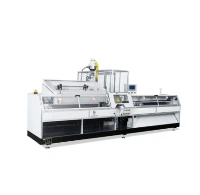
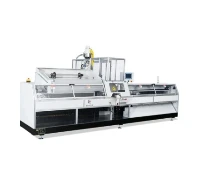
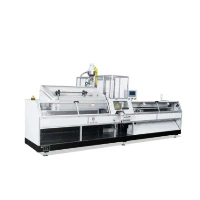
The company's CS-G8811L Fully Automatic Paint Roller Thermal Fusion Winding Machine (Glue) is a high-performance automated equipment specifically designed for pipe-type roller brush gluing and fabric winding. The equipment features standard integrated precision slide rail modules delivering high precision, excellent stability, and long-lasting durability; and maintenance-free rotating clamping assemblies with brushless conductive ring design to reduce maintenance costs and increase production capacity. The export standard configuration adopts the Siemens control system from Germany (touch screen + PLC + servo motor); the standard configuration adopts China's innovative control system (touch screen + PLC + servo motor). The equipment is equipped with 5 servo motors, enabling smaller fabric gaps, easier operation, and more convenient changing of different diameter tubes. The premium EPC access system is optional for connecting to factory Industry 4.0 systems, ERP systems, and equipment network monitoring systems. All products are manufactured in strict compliance with international industry standards and quality systems.