
I. Global Paint Roller Market Enters a Period of Structural Growth
According to the latest industry report released by QYResearch, global sales of adjustable paint roller brushes reached USD 3.228 billion in 2025 and are projected to reach USD 4.611 billion by 2032, with a compound annual growth rate (CAGR) of 5.3%. Meanwhile, the global roller brush market reached USD 4.73 billion in 2025, representing growth of approximately 31.7% compared to 2020. China, as the world's largest roller brush production base, will continue to be the single largest contributor to incremental growth.
Data from the Paint Rollers Market Report 2026 further confirms this trend: the global paint roller market will grow from USD 3.48 billion in 2025 to USD 3.78 billion in 2026, at a CAGR of 8.5%-. Behind this growth lies the sustained expansion of the construction decoration, industrial maintenance, and DIY home improvement markets.
However, market expansion is not simply a matter of volume growth. The European paint roller market report points out that the industry is undergoing a "decade-long transformation" - the era of low-cost, high-volume production is coming to an end, replaced by comprehensive requirements for product consistency, flexible production, and environmental compliance. In 2025, cumulative patent applications in the industry exceeded 12,000, with patents related to fiber material modification, microporous structure optimization, and eco-friendly adhesive technologies accounting for over 34%. This means that the technological upgrading of downstream roller products is, in turn, forcing a fundamental transformation of upstream production equipment.
II. Limitations of Traditional Thermofusion Winding Processes
The core of paint roller production lies in uniformly and firmly winding and bonding textile fabric onto PP core tubes. For a long time, the industry has relied primarily on two thermofusion processes: hot-melt adhesive bonding and flame thermofusion.
The working principle of flame thermofusion winding machines is to use an open flame to heat the surface of the PP core tube to a molten state, after which the fabric is pressed onto it. While this method has relatively low equipment costs, it suffers from several insurmountable drawbacks: temperature control precision is limited, as flame temperature is significantly affected by ambient airflow, making it difficult to regulate precisely within a narrow range; open-flame operations pose safety hazards and require high workshop environmental standards; and fabric bonding uniformity depends on operator experience, making batch-to-batch consistency difficult to guarantee.
Although the hot-melt adhesive approach avoids the risk of open flames, it requires additional adhesive procurement and storage costs, and some adhesives contain volatile organic compounds (VOCs), creating potential conflicts with increasingly stringent environmental regulations in the European Union. Patent research shows that the use of fabric backing and adhesives in traditional methods not only increases raw material costs but also adds complexity to inventory management.
III. Technological Breakthrough of Ultrasonic Thermofusion Winding
The emergence of ultrasonic thermofusion winding technology provides a systematic solution to the aforementioned pain points. Its core principle is to utilize high-frequency mechanical oscillations (typically 20kHz–40kHz) to generate intermolecular friction heat at the contact surface of thermoplastic materials, causing the materials to melt and achieve permanent welding within an extremely short time.
Compared with traditional flame processes, the advantages of the ultrasonic approach are manifested in multiple dimensions:
Precise temperature control and uniform bonding. Ultrasonic energy generates heat only at the welding point, with a minimal heat-affected zone, avoiding overall thermal damage to the fabric caused by flame heating. Research indicates that ultrasonic vibration energy synchronously melts and compacts thermoplastic resin/fiber wound composite materials during the winding process, ensuring uniform fiber tension throughout winding.
Elimination of open-flame safety hazards. No open flame exists during ultrasonic welding, fundamentally eliminating fire risks while reducing investment in workshop ventilation and exhaust gas treatment.
Reduction in raw material costs. Ultrasonic welding does not require adhesives; the fabric and PP core tube are directly fused. Patent data shows that adopting ultrasonic processes can eliminate certain processing steps (especially the pre-fabricated fabric strip manufacturing process), significantly reducing the demand for fabric backing and core materials, thereby lowering raw material costs and inventory requirements.
Improved product consistency. The parameters of ultrasonic welding (amplitude, pressure, welding time) can be digitally set and precisely controlled, ensuring a high degree of consistency in product quality between batches. This is particularly important for roller manufacturers exporting to European markets - European customers have far higher requirements for fabric bonding strength and appearance consistency than other markets.
IV. Equipment Selection Amid the Industry-Wide Automation Wave
The global paint roller manufacturing industry is accelerating toward a high degree of automation and intelligence. Market demand has shifted from the simple pursuit of low cost and high output to a comprehensive focus on product consistency, flexible production, energy conservation and environmental protection, and data-driven management.
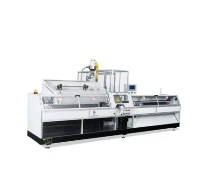
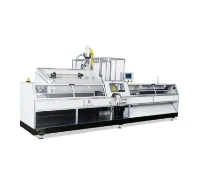
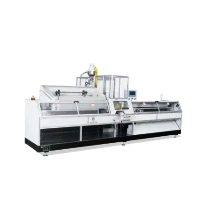
Against this backdrop, equipment selection has become a key variable in the competitiveness of roller manufacturers. Taking Foshan Chaosheng Automation Equipment Co., Ltd. as an example, the company has been deeply engaged in the field of paint roller automation equipment for over 20 years. Its automatic thermofusion winding machines support both adhesive and flame dual modes, while also offering 6-in-1 finishing machines, end-wrapped roller production lines, and mini roller production lines as supporting equipment-. Its products have been exported to Spain, Italy, the Czech Republic, Bulgaria, Mexico, Brazil, Colombia, and other countries and regions, and it is also a regular supplier to major manufacturing countries in Southeast Asia and Africa.
It is worth noting that leading roller equipment manufacturers in the industry are integrating ultrasonic technology into winding equipment. Edward Jackson Ltd.'s Helix series thermofusion winding machines are renowned for their high output, and the Helix+ model offers significant advantages over traditional flame thermofusion winding machines in terms of energy efficiency and safety. This marks an accelerating migration of the industry's technological path from "flame" to "ultrasound."
V. Investment Recommendations for Roller Manufacturers
For roller manufacturers currently considering equipment upgrades or new production lines, the following points merit inclusion in the decision-making framework:
First, clarify the compliance requirements of target markets. Products exported to European markets are subject to strict standards for VOC emissions and bonding strength. The environmental advantages of ultrasonic processes can be directly translated into market access advantages.
Second, evaluate full lifecycle costs rather than equipment price alone. The initial investment in ultrasonic equipment is higher than that of flame equipment, but it eliminates adhesive procurement costs, open-flame safety facility investments, and higher energy consumption costs. The investment payback period is typically 12–18 months.
Third, focus on the equipment's flexible production capability. Global market demand for roller specifications is increasingly diversified - from mini rollers (diameter ≤30mm) to standard rollers (38mm–44mm). The equipment's rapid changeover and specification adjustment capabilities directly affect order response speed and equipment utilization.
Fourth, examine the supplier's technical support and export experience. Selecting equipment suppliers with CE certification and extensive export experience can effectively reduce communication costs during equipment commissioning and after-sales maintenance.
The popularization of ultrasonic thermofusion winding technology will not happen overnight, but the trend is already clear. Under the triple pressure of sustained growth in the global roller market, increasingly stringent environmental regulations, and continuously rising labor costs, manufacturers that complete technological upgrades first will occupy an advantageous position in the next round of competition.