
I. Industry Context: Structural Growth in the Paint Applicator Market
The global paint roller market is in a steady expansion cycle. According to industry research, the global paint roller market was valued at approximately USD 3.09 billion in 2025, and is projected to grow at a CAGR of 5.50% from 2026 to 2035, reaching approximately USD 5.28 billion by 2035. Another report indicates the market will grow from USD 3.48 billion in 2025 to USD 3.78 billion in 2026, at a CAGR of 8.5%. While figures vary slightly due to differing statistical methodologies, the growth trajectory is consistent.
Several factors underpin this growth. The acceleration of commercial infrastructure development is a core driver - paint rollers offer significant efficiency advantages in large-area coating applications, making them the tool of choice for commercial real estate, retail spaces, and industrial facilities. Meanwhile, the continued activity of the DIY home improvement market and demand from professional painting contractors for high-quality roller sleeves together form a stable market foundation.
Notably, demand for premium microfiber and woven roller covers in professional channels remains stable, providing a resilient revenue base for quality-oriented roller manufacturers. Market growth imposes clear requirements on the manufacturing side: higher throughput, more consistent quality, and cleaner production processes.
II. Technical Evolution: The Path from Flame to Hot Melt Adhesive Extrusion
At its core, the manufacture of paint roller sleeves involves firmly attaching fabric (nap) to the surface of a plastic tube core, typically a PP tube. This process has undergone decades of technological iteration.
Early industrial production relied primarily on the "flame" method - heating the plastic tube surface with a flame to melt it, then pressing the fabric onto it. While simple in principle, this approach had significant technical limitations: heating temperature depended on operator experience, uneven tube heating led to inconsistent bond strength, open-flame operations posed safety hazards, and continuous production was difficult to achieve, limiting output.
The introduction of hot melt adhesive extrusion technology fundamentally changed this landscape. The principle is straightforward: a hot melt adhesive extrusion mechanism heats and melts PP (polypropylene) adhesive, uniformly extrudes it onto the tube surface, and completes bonding during the fabric winding process. The core advantage of this technical path lies in the fact that the bonding process no longer depends on the melting of the tube itself, but is accomplished by an independent hot melt adhesive layer - with temperature, adhesive volume, and application speed all precisely controllable.
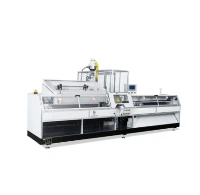
From a process parameter perspective, modern thermofusion winding equipment achieves operating speeds of 8 to 9 meters per minute, with a single machine capable of producing approximately 300 long sleeves per hour (equivalent to about 1,400 brush units for 9-inch rollers). The complete line operates at approximately 8KW, compatible with 380V industrial voltage. Compared to the flame method's production speed of approximately 1.2 meters per minute, this represents a several-fold efficiency improvement. More importantly, the hot melt extrusion process eliminates open-flame hazards, reduces operator requirements from 2-3 persons to a single operator overseeing multiple machines, and fundamentally improves both production safety and labor structure.
III. System Composition and Key Technologies of Thermofusion Winding Equipment
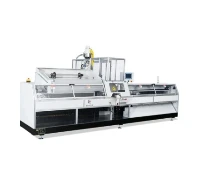
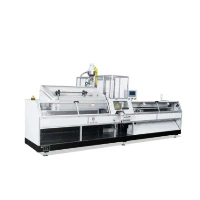
A complete thermofusion winding system is not a single machine but a production line system composed of multiple functional modules working in coordination.
The tube core feeding system is responsible for continuously delivering PP tubes to the processing station. Automatic tube loading mechanisms use robotic arms or chain conveyor systems to achieve directional alignment and rhythmic supply of tubes, ensuring production continuity.
The hot melt adhesive extrusion mechanism is the core unit of the entire system. Its function is to heat solid hot melt adhesive pellets to a molten state and uniformly apply them to the tube surface through an extrusion die. The uniformity of the adhesive layer directly determines the bond strength between fabric and tube core, making the die design and temperature control precision critical process parameters.
The fabric winding mechanism winds pre-cut fabric strips onto the adhesive-coated tube in a helical path. Tension must be precisely controlled during winding - excessive tension causes fabric deformation, while insufficient tension may create bubbles or wrinkles. Modern equipment typically incorporates tension feedback systems for closed-loop control of the winding process.
The cutting and discharge system cuts the long sleeve to required lengths after winding is complete, and automatically discharges the tube to the next process. This stage can interface with subsequent end-cap inserting machines, 6-in-1 finishing machines, and other equipment to form a complete production chain.
It is worth noting that seamless roller cover manufacturing represents an important technical direction in the industry. Traditional seamed covers may show seam marks during use, affecting the smoothness of the painted surface. Technical solutions based on tubular knitted fabrics and heat-activated thermal bonding materials can thermally bond fabric to the inside of a cylindrical forming tube without stretching the fabric, enabling semi-rigid roller cover production while avoiding surface defects.
IV. Equipment Selection Logic from a Market Data Perspective
For paint roller manufacturers, equipment selection is not merely a technical decision but a commercial one aligned with market demand.
From market data, demand for professional-grade microfiber and woven roller covers continues to grow. These products impose higher requirements on bond strength between fabric and tube, surface flatness, and batch consistency - precisely the areas where thermofusion winding equipment's process control precision provides advantages.
The global hot melt adhesive automatic coating equipment market was valued at approximately USD 1.32 billion in 2025 and is projected to grow to USD 2.5 billion by 2035, at a CAGR of approximately 6.6%. Behind this growth lies a technological trend toward "higher speed, greater precision, and intelligence" - equipment must not only be fast but must maintain coating precision and bonding quality stability at high speeds.
From a regional market perspective, European professional painting markets continue to invest in premium roller cover quality as a professional productivity driver. In North America, demand from professional painting contractor channels for microfiber and woven roller covers remains stable. The quality requirements these markets place on roller products indirectly constitute technical thresholds for upstream manufacturing equipment.
V. Automation Integration and Production Line Synergy
Within the paint roller production system, thermofusion winding equipment is not an isolated production unit but the starting point of an entire production line.
In current production organization models, long sleeves after winding require cutting, end-cap insertion, finishing, and multiple other processes before becoming finished products. Line-level integration of winding machines with 6-in-1 finishing machines, automatic end-cap inserting machines, and similar equipment can significantly reduce the turnaround time between processes from tube core to finished product.
The underlying logic of this integration approach is that paint roller production involves multiple processes. In traditional models, inter-process handling relies on manual transport and intermediate inventory, which not only occupies workshop space but also increases quality fluctuation risk. Through production line synergy, tubes automatically proceed to the next station after winding, requiring no manual intervention throughout the entire process - ensuring process consistency while reducing labor costs and material turnover losses.
Industry exhibition dynamics also reflect this trend. International brush manufacturing exhibitions such as CIBRUSH have adopted "Brush Making is Getting Smarter" as their core theme, focusing on the application of automation and intelligent technologies in the brush manufacturing sector. The automation upgrade of paint roller manufacturing equipment has become an industry consensus rather than an optional choice.
VI. Conclusion
The thermofusion winding process for paint roller sleeves is essentially a technical proposition of "precision replacing experience." From relying on manual control of flame temperature, to achieving precise application through hot melt adhesive extrusion, to production-line-level automation through multi-equipment coordination - each technological iteration responds to the same question: how to ensure consistent quality of every roller sleeve while increasing output.
Against the backdrop of steady growth in the global roller market, manufacturing-side technological upgrading is no longer " icing on the cake" but a necessary path to address rising labor costs, increasing quality requirements, and environmental compliance pressures. For paint roller manufacturers, selecting a thermofusion winding solution suited to their product positioning and production scale is a critical decision point in this round of industrial upgrading.